
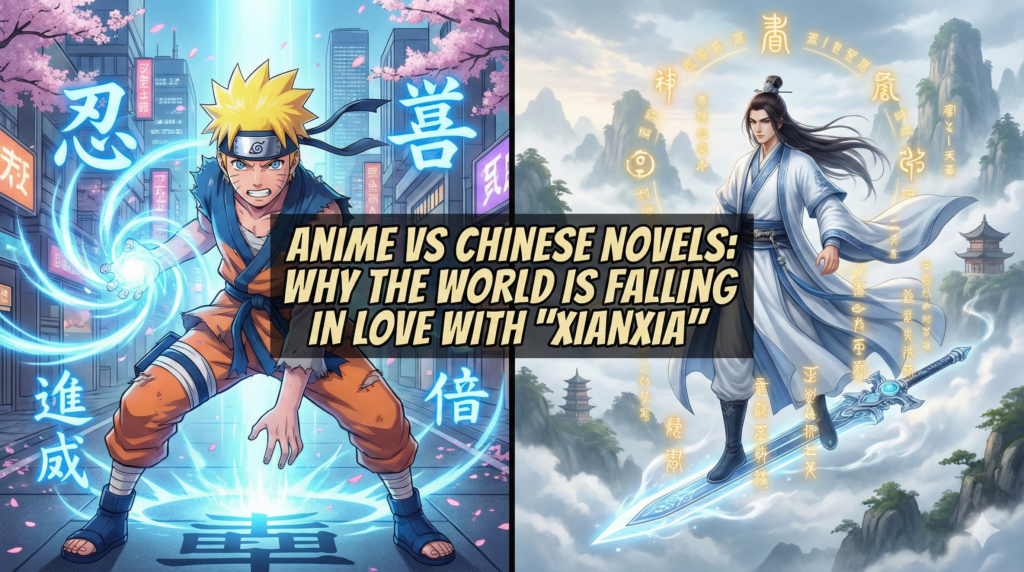
For decades, Japanese Anime has been the undisputed king of East Asian entertainment in the West and India. From Naruto’s ninja way to Goku’s Super Saiyan transformations, we’ve loved the “power-up” culture.
However, a new titan has emerged that is stealing the spotlight: Chinese Xianxia (Cultivation) Novels. If you’ve spent any time on the internet lately, you’ve likely seen terms like “Dao,” “Foundation Establishment,” or “Dual Cultivation.” But why is everyone suddenly obsessed with these stories? Let’s break down the battle between Anime and Chinese Novels.
1. The “Power System” is More Satisfying
In many Shonen Animes, characters get “power-ups” through the power of friendship or sudden emotional outbursts.
In Xianxia, power is earned through a rigorous, almost scientific system called Cultivation. Readers love the clear progression:
- Stages: Moving from Body Refining to Soul Transformation feels like a massive achievement.
- Alchemy & Resources: The hunt for rare medicinal pills and ancient spirit herbs adds a layer of “gaming” logic that is incredibly addictive.
2. Stakes That Scale Beyond the Universe
While an Anime might focus on saving a village or a planet, Xianxia novels operate on a mind-blowing scale.
- Time: Characters don’t just train for months; they meditate for hundreds of years.
- Space: Protagonists often travel across different “Realms,” “Planes,” and “Universes,” eventually challenging the Heavens themselves.
- The Goal: It’s not just about being the strongest; it’s about attaining Immortality.
3. The “Face-Slapping” Trope (Satisfaction Guaranteed)
Let’s be honest: nothing beats the satisfaction of a “hidden expert” post. Chinese novels have perfected the art of the “Face-Slap.” An arrogant young master from a rich sect insults the “weak” protagonist, only to be utterly destroyed when the hero reveals his true power. It’s a repetitive trope, but for readers, it provides a dopamine hit that standard Anime often misses.
4. Deep Lore and Mythology
Xianxia isn’t just “magic.” It is deeply rooted in Chinese folklore, Taoism, and Buddhism. The concept of the “Dao” (The Way) adds a philosophical depth to the action. You aren’t just watching a fight; you are watching a character try to understand the laws of the universe (Gravity, Time, Space, Karma).
5. From Novel to ‘Donghua’ (Chinese Anime)
The rise of Donghua (Chinese 3D/2D Animation) like Soul Land, A Will Eternal, or Perfect World has bridged the gap. Fans who find reading thousands of chapters intimidating are being drawn in by the stunning visuals of these shows, eventually leading them back to the original web novels.
Is Xianxia the New Anime?
Anime will always have a special place in our hearts, but Chinese Novels offer a “long-form” immersion that 24-minute episodes can’t match. Whether it’s the epic journey of Long Chen in Nine Star Hegemon Body Art or the cunning of Han Li in A Record of a Mortal’s Journey to Immortality, the world of Cultivation is here to stay.
Are you a fan of Anime or have you crossed over to the world of Cultivation? Let us know your favorite novel in the comments!