


Table of Contents
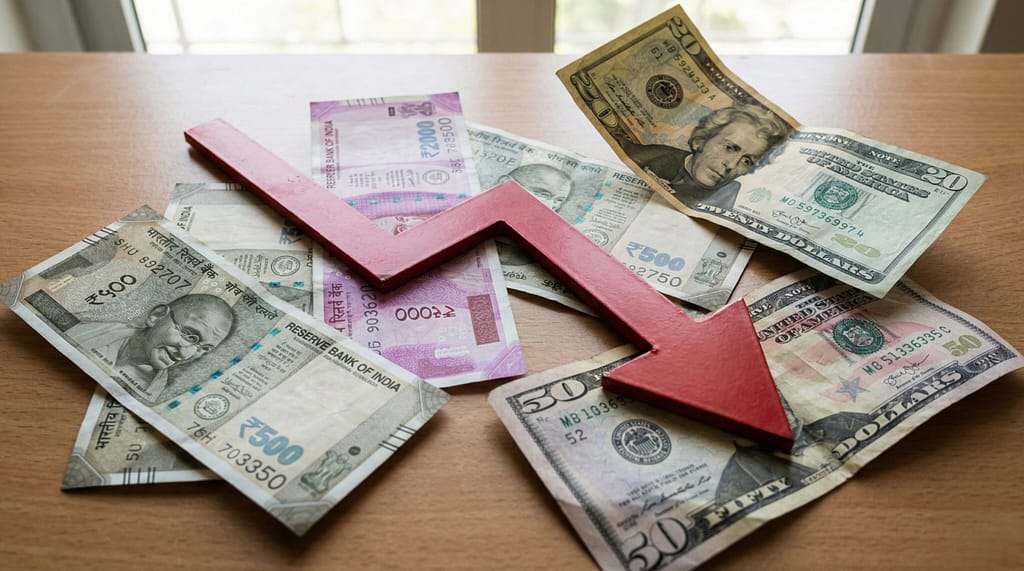
Rupee record low against dollar has sent shockwaves through India’s financial markets as the Indian currency breached the ₹85 mark for the first time in history. This unprecedented weakness in the rupee affects every Indian—from students planning foreign education to businesses importing raw materials, from travelers booking international trips to investors watching their portfolios. The rupee’s decline represents more than just numbers on currency exchange boards; it signals fundamental shifts in India’s economic position and has immediate, tangible consequences for household budgets and business operations.
The rupee record low against dollar didn’t happen overnight. It’s the culmination of multiple global and domestic pressures that have been building for months, creating a perfect storm that’s pushed India’s currency to historic weakness against the world’s dominant reserve currency.
Understanding the Rupee’s Historic Fall
The rupee record low against dollar marks a significant milestone in India’s economic history. The currency has depreciated steadily over decades, but recent acceleration raises particular concerns.
In January 2026, the rupee crossed ₹85 per dollar, compared to approximately ₹83 just months earlier. This represents roughly 2.5% depreciation in a short period—significant for a major economy’s currency.
Historical context shows the rupee traded around ₹45-48 per dollar in 2013-14. The journey from there to ₹85+ represents nearly 75% depreciation over roughly a decade.
Currency depreciation of this magnitude affects India’s $3.7 trillion economy profoundly. Every rupee that falls means imports cost more, inflation rises, and purchasing power erodes.
The rupee record low against dollar comes despite India’s relatively strong economic growth. GDP growth of 6-7% should theoretically support currency strength, yet the rupee weakens—indicating structural issues.
Exchange rate dynamics involve complex interactions between trade flows, capital movements, central bank policies, and market sentiment. All these factors currently work against the rupee.
India’s foreign exchange reserves, while substantial at over $650 billion, face pressure from defending the rupee. RBI interventions to prevent freefall deplete these reserves, limiting future defensive capacity.
Why Is the Rupee Falling Against the Dollar?
Multiple interconnected factors drive the rupee record low against dollar. Understanding these causes helps predict future movements and prepare for consequences.
Trade deficit remains fundamental issue. India imports significantly more than it exports, creating constant dollar demand exceeding supply. This structural imbalance exerts downward pressure on rupee.
Oil imports constitute major drain on foreign exchange. India imports over 80% of crude oil requirements, and payments in dollars mean higher oil prices directly weaken the rupee.
Capital outflows by foreign investors selling Indian stocks and bonds reduce dollar supply in Indian markets. When foreign institutional investors (FIIs) withdraw funds, they convert rupees to dollars, depressing rupee value.
The rupee record low against dollar reflects US Federal Reserve policy. Higher US interest rates make dollar assets more attractive, pulling capital from emerging markets like India toward American investments.
Global risk aversion during geopolitical tensions strengthens the dollar as safe haven. Investors worldwide buy dollars during uncertainty, increasing its value against all currencies including the rupee.
Speculation and market psychology compound fundamentals. Once depreciation begins, traders bet on further weakness, creating self-fulfilling prophecy that accelerates decline.
Domestic inflation higher than US inflation erodes rupee’s purchasing power. When Indian prices rise faster than American prices, the rupee must depreciate to maintain purchasing power parity.
Global Economic Factors Driving the Decline
International developments beyond India’s control significantly influence the rupee record low against dollar. Global economic architecture inherently favors dollar strength.
US economic resilience surprises markets. Strong American growth allows Federal Reserve to maintain high interest rates longer than expected, making dollar investments more attractive.
Dollar’s status as global reserve currency creates structural demand. International trade predominantly occurs in dollars, central banks hold dollar reserves, and commodities price in dollars—all supporting dollar strength.
The rupee record low against dollar mirrors weakness in other emerging market currencies. Turkish lira, Brazilian real, and South African rand all face similar pressures, indicating global rather than India-specific dynamics.
Geopolitical tensions from Ukraine war to Middle East conflicts drive safe-haven flows to dollars. During uncertainty, global investors prefer dollar assets regardless of returns.
China’s economic slowdown affects India indirectly. Reduced Chinese demand for commodities and manufactured goods slows global growth, benefiting defensive dollar holdings.
European economic weakness prevents euro from offering dollar alternative. Euro zone struggles mean investors have fewer options besides dollars for large-scale investments.
According to the International Monetary Fund’s latest World Economic Outlook, emerging market currencies face sustained pressure from developed world monetary policies—a trend clearly affecting India’s rupee.
India’s Economic Challenges Contributing to Weakness
Domestic factors compound global pressures, making the rupee record low against dollar partly homegrown. India’s economic fundamentals, while improving, contain vulnerabilities.
Current account deficit widens as imports grow faster than exports. Despite government efforts to boost exports, trade imbalance persists, requiring continuous dollar purchases to pay for excess imports.
Fiscal deficit remains elevated despite consolidation efforts. Government borrowing crowds out private investment and raises inflation concerns, making rupee assets less attractive to foreign investors.
The rupee record low against dollar reflects inflation running above RBI’s target range. Consumer price inflation around 5-6% exceeds comfortable levels, eroding currency value.
Manufacturing competitiveness lags competitors like Vietnam and Bangladesh. Despite Make in India initiatives, export growth disappoints, limiting dollar inflows from foreign sales.
Infrastructure bottlenecks raise production costs. Logistics inefficiencies, power shortages, and regulatory complexities make Indian exports expensive compared to competitors.
Banking sector stress from bad loans constrains credit growth. Financial sector weaknesses limit economic dynamism needed to generate strong export performance and foreign investment.
Policy uncertainty around taxation and regulations sometimes deters foreign investment. Retrospective tax controversies and regulatory changes create nervousness among international investors.
Impact on Common Indians: Daily Life Changes
The rupee record low against dollar isn’t abstract financial news—it affects household budgets immediately and significantly. Common Indians feel consequences across multiple dimensions.
Imported goods become more expensive. Electronics, toys, machinery, and countless products with imported components see price increases as rupee weakens.
Fuel prices rise as oil import costs increase. Higher petrol and diesel prices cascade through economy, raising transportation costs and food prices.
The rupee record low against dollar means inflation accelerates across categories. Even domestically produced goods cost more when inputs like machinery, chemicals, or components are imported.
Medications and healthcare costs increase. India imports significant pharmaceutical raw materials, and currency weakness raises medicine prices.
Gold and jewelry become more expensive. Indians’ favorite investment and cultural necessity costs more as international gold prices convert to rupees at worse rates.
Household budgets face squeeze as purchasing power erodes. The same salary buys less when import-driven inflation rises due to currency depreciation.
Savings lose value in real terms. While bank balances remain nominally same, their purchasing power for imported goods and international services diminishes.
How Importers and Exporters Are Affected
Businesses engaged in international trade experience the rupee record low against dollar most directly. Currency movements create both opportunities and severe challenges.
Importers face margin compression as dollar purchases cost more rupees. Businesses importing raw materials, machinery, or finished goods see costs spike, squeezing profitability.
Pricing pressure intensifies for import-dependent businesses. They must either absorb higher costs (reducing profits) or raise prices (risking lost customers).
The rupee record low against dollar benefits exporters by making Indian goods cheaper internationally. Software services, textiles, pharmaceuticals, and manufactured exports become more competitive.
IT sector profits improve when dollar revenues convert to more rupees. Companies like TCS, Infosys, and Wipro see automatic profit boosts from currency translation.
However, exporters with imported inputs face mixed impact. While foreign sales generate more rupees, imported components also cost more, partially offsetting benefits.
Currency hedging becomes expensive but necessary. Businesses use forward contracts and options to lock exchange rates, but these instruments cost money and aren’t always perfectly effective.
Small and medium enterprises struggle most. Large corporations can hedge currency risk and negotiate better rates; SMEs lack these sophistications and suffer disproportionately.
Education and Travel Costs Skyrocket
Perhaps no group feels the rupee record low against dollar more acutely than students and travelers. International education and travel become significantly more expensive.
Foreign education costs surge for Indian students. Tuition, accommodation, and living expenses in US, UK, or other countries become substantially more expensive in rupee terms.
A $50,000 annual tuition that cost ₹41.5 lakhs at ₹83 exchange rate now costs ₹42.5 lakhs at ₹85—₹1 lakh more for the same education.
The rupee record low against dollar forces families to reconsider study abroad plans. Some students defer enrollment, choose cheaper destinations, or abandon foreign education entirely.
Education loans become larger in rupee terms. Students borrowing to fund foreign education face bigger debt burdens that take longer to repay.
International travel becomes luxury for many middle-class families. Vacation costs in dollars, euros, or pounds increase substantially, making foreign trips unaffordable.
Business travel budgets face pressure. Companies sending employees abroad pay more for flights, hotels, and expenses, leading to travel restrictions and virtual meetings.
Remittances from students or travelers shrink in value. Money sent back to India converts to fewer rupees, reducing family support from abroad.
What This Means for Indian Stock Markets
The rupee record low against dollar creates complex dynamics for Indian equity markets. Stock market impacts vary by sector and investor category.
Foreign institutional investors face currency losses that offset stock gains. Even if Indian stocks rise in rupee terms, FIIs earn less in dollar terms when converting back.
FII selling pressure accelerates during currency weakness. Foreign investors often exit emerging markets facing currency depreciation, creating downward spiral.
The rupee record low against dollar benefits export-oriented companies. IT, pharmaceuticals, and textile stocks often rally during rupee weakness as their profitability improves.
Import-dependent sectors face headwinds. Airlines, oil marketing companies, and businesses relying on imported inputs see margin pressure and stock price weakness.
Domestic consumption stocks show mixed performance. While Indian consumers face inflation from currency weakness, strong domestic growth can offset negative impacts.
Market volatility increases during currency turbulence. Uncertainty about rupee direction and its economic implications makes investors cautious, increasing price swings.
Long-term investors find opportunities during currency-driven selloffs. Quality companies become cheaper when FIIs sell due to currency concerns rather than business fundamentals.
RBI’s Response and Intervention Measures
The Reserve Bank of India hasn’t remained passive during the rupee record low against dollar. Central bank interventions aim to smooth volatility and prevent panic.
Dollar sales from forex reserves support the rupee temporarily. RBI sells dollars and buys rupees, increasing rupee demand and slowing depreciation.
However, intervention depletes forex reserves that serve as economic buffer. Reserves dropped from peak levels, limiting RBI’s ammunition for future defense.
The rupee record low against dollar occurs despite RBI intervention, indicating market forces overwhelming central bank capacity. Sustained intervention becomes unsustainable.
Interest rate policy balances inflation and growth concerns. Higher rates might support rupee by attracting foreign investment but could slow economic growth.
RBI allows managed depreciation rather than fixed rates. Preventing all rupee weakness would exhaust reserves quickly, so gradual depreciation is permitted while extreme volatility is prevented.
Forward market interventions through swaps provide additional tools. RBI operates in futures and forwards markets to influence currency expectations.
Communication and guidance attempt to manage market psychology. RBI statements reassure markets about adequate reserves and commitment to stability.
Comparing with Other Emerging Market Currencies
The rupee record low against dollar must be contextualized globally. How does India’s currency perform relative to other emerging economies?
Most emerging market currencies depreciate against dollar simultaneously. This common weakness indicates global dollar strength rather than India-specific problems.
Turkish lira performs worse than rupee, losing 30-40% in similar period. Argentina’s peso collapses completely, making rupee’s decline seem moderate.
The rupee record low against dollar roughly matches Brazilian real and South African rand depreciation. Similar emerging markets face similar pressures.
Asian currencies like Thai baht and Malaysian ringgit also weaken, though some like Indonesian rupiah show relative resilience.
Chinese yuan depreciation affects regional dynamics. As China allows yuan weakness to support exports, other Asian currencies including rupee face competitive pressure.
However, rupee volatility remains lower than many peers. RBI’s management prevents wild swings seen in some other emerging markets.
India’s better economic fundamentals—stronger growth, controlled inflation, adequate reserves—mean rupee outperforms truly troubled currencies while still reaching record lows.
Oil Prices and the Rupee Connection
The relationship between oil prices and the rupee record low against dollar represents crucial dynamics for India’s import-dependent energy sector.
India imports over 85% of crude oil requirements. This massive import bill constitutes single largest component of trade deficit.
Every dollar increase in oil prices costs India approximately $2 billion annually in additional import expenses. These dollars must be purchased with rupees, creating depreciation pressure.
The rupee record low against dollar compounds oil price impacts. When oil costs $80 per barrel, the rupee price varies dramatically based on exchange rate.
At ₹83 per dollar, $80 oil costs ₹6,640 per barrel. At ₹85, the same oil costs ₹6,800—₹160 more without any change in dollar price.
Geopolitical tensions affecting oil prices create double challenge. If Middle East conflicts raise oil to $90 while rupee weakens, India faces multiplied cost increases.
Government subsidies on fuel limit consumer price impact but strain fiscal position. Protecting consumers from full oil price increases creates budget deficits that ultimately weaken rupee further.
Renewable energy and electric vehicle adoption become economically urgent. Reducing oil import dependency offers only long-term solution to this structural rupee weakness driver.
How NRIs and Remittances Are Impacted
Non-Resident Indians experience the rupee record low against dollar differently than residents. For NRIs, currency movements create both opportunities and challenges.
Remittances to India become more valuable in rupee terms. The same dollar, pound, or dirham converts to more rupees, benefiting families receiving support.
NRI investments in Indian real estate and assets appear cheaper in foreign currency terms. Properties or stocks that seemed expensive now cost fewer dollars.
The rupee record low against dollar makes India vacations more affordable for NRIs. Travel, shopping, and family support go further when converting strong foreign currencies.
However, NRI assets in India lose value in foreign currency terms. Property or investments held in rupees translate to fewer dollars when converted back.
Pension income in rupees disappoints when converted to foreign currency. Retirees living abroad on Indian pensions find their purchasing power declining.
The timing of conversions becomes crucial. NRIs strategize about when to convert currencies, trying to maximize rupee weakness for inflows or minimize impact for outflows.
This trend ties into broader patterns where Indian youth are seeking opportunities abroad, partly motivated by stronger foreign currency earnings.
Expert Predictions: Where Is the Rupee Headed?
Financial experts analyzing the rupee record low against dollar offer varied predictions. Forecasts depend on assumptions about global and domestic factors.
Pessimistic forecasts see rupee reaching ₹87-90 if current trends continue. Extended US rate hikes, rising oil prices, and FII outflows could drive further weakness.
Optimistic scenarios predict stabilization around ₹84-85. Improved export performance, FII return, and RBI intervention might arrest the decline.
The rupee record low against dollar may represent new normal rather than temporary spike. Long-term structural factors suggest gradual depreciation continuing indefinitely.
Most experts expect ₹85-87 range through 2026. Volatile movements within this band likely as different factors dominate at different times.
Technical analysts identify support and resistance levels. Charts suggest ₹86 as next resistance, while ₹84 might provide support if reversal occurs.
Seasonal patterns affect predictions. Typically, rupee strengthens during October-March due to festival demand and portfolio inflows, weakening April-September.
Election cycles and policy changes create uncertainty. Major reforms or policy shifts could dramatically alter rupee trajectory in either direction.
What You Can Do to Protect Your Finances
Individuals and businesses can take concrete steps to manage the rupee record low against dollar impact on their finances.
Diversify currency exposure for those able to access foreign currency. Maintaining some dollar or other currency assets hedges against further rupee weakness.
Advance planning for foreign expenses helps. Booking international travel, paying education fees early, or buying imported goods before further depreciation saves money.
The rupee record low against dollar makes domestic alternatives more attractive. Choosing Indian products over imports, domestic tourism over foreign travel, protects against currency impact.
Investment diversification across asset classes provides protection. Gold, international mutual funds, and export-oriented stocks can hedge currency risk.
Avoid unnecessary dollar-denominated debt. Loans in foreign currency become more expensive to repay as rupee weakens.
For businesses, implement currency hedging strategies. Forward contracts, options, and natural hedges through matching currency revenues and expenses mitigate risk.
Stay informed about economic trends affecting rupee. Understanding drivers helps anticipate movements and time major currency-dependent decisions better.
The small business revolution in India often benefits from focusing on domestic markets less affected by currency fluctuations.
Long-Term Implications for Indian Economy
Beyond immediate impacts, the rupee record low against dollar carries profound long-term implications for India’s economic trajectory and global position.
Persistent currency weakness signals structural economic challenges. While growth remains strong, productivity, competitiveness, and export capacity need improvement.
Import substitution and domestic manufacturing gain urgency. Currency weakness makes Make in India economically compelling beyond nationalist rhetoric.
The rupee record low against dollar may accelerate India’s push for strategic autonomy. Reducing dependence on dollar-denominated imports becomes national security issue, particularly for defense and energy.
Foreign investment patterns may shift. While weak rupee attracts some bargain hunters, sustained depreciation raises questions about economic management and stability.
India’s global economic ranking may stagnate or decline in dollar terms. Even with strong rupee growth, dollar GDP grows slower when currency depreciates.
Debt sustainability improves for domestic borrowing but worsens for external debt. Government bonds in rupees become easier to service while any dollar debt becomes more burdensome.
The phenomenon connects to global geopolitical shifts where economic power determines international influence.
Consumer behavior may permanently change toward more price-conscious, value-oriented purchasing. Experience with inflation and currency weakness creates lasting impact on spending patterns.
The rupee record low against dollar ultimately represents both challenge and opportunity—a wake-up call demanding structural reforms while creating competitive advantages for Indian exporters and entrepreneurs who can capitalize on currency-driven cost advantages to compete globally.
Written By SHARK